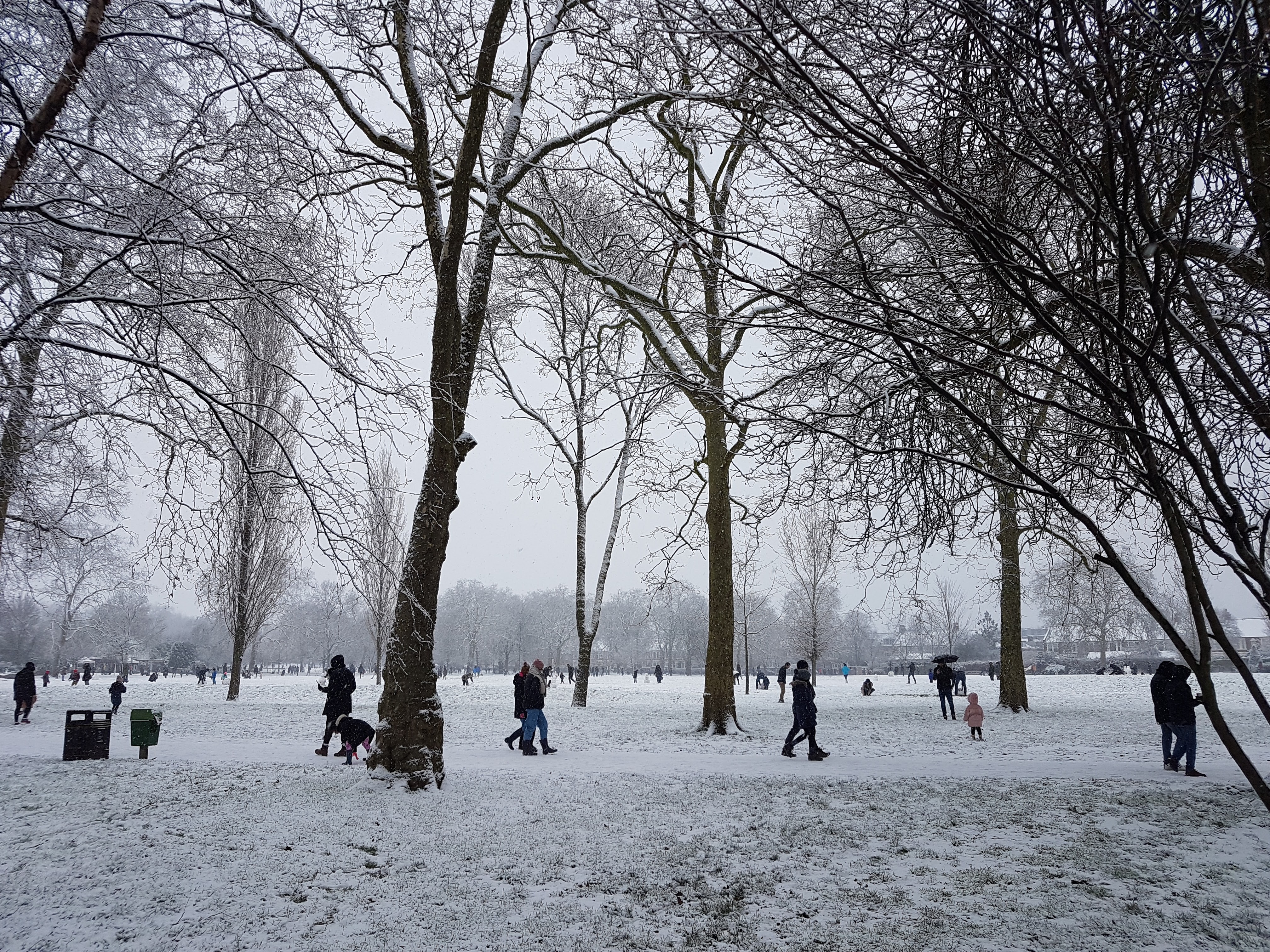
Today it snowed for a couple of hours across the capital. Proper big snowflakes that quickly covered the frozen ground. The sort of snow that enticed even teenagers out of the house to have some fun. For some small children, this was their first sight of a snowy world. And probably for everyone the sight of a white landscape brings a little magic to an otherwise fairly miserable January.
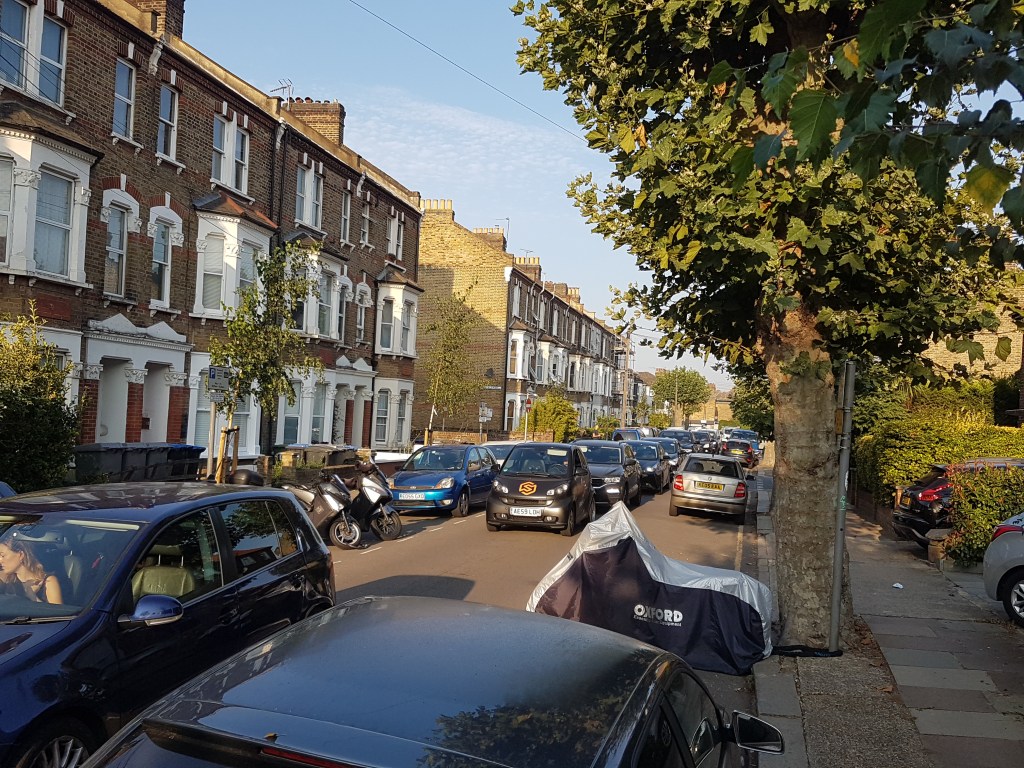
But my enjoyment of this beautiful day has been marred by the sight of dozens of 4×4 vehicles parked, cold and covered in snow. What is the matter with you, 4×4 owners? Today is your big day! Your chance to show off, to put your beloved tractor to the test, to munch up those slippery streets. Where is your usual nonchalance? You urban folk who insist on driving Range Rovers and Jeeps and giant Audis despite living in a city that enjoys 100% paved roads and a comprehensive public transport system and also has illegal air pollution levels – surely you want to get out there and put your foot down!
Let’s say, for argument’s sake, that these snowy conditions affect London once a year (probably an overestimate). That is 0.27% of the year. So, for 99.73% of the year, that off-road capability is redundant.
But never mind, because you look really cool driving your children around the corner to school and acting like there is no climate crisis WHATSOEVER.
Well, here we are in October 2020, and the second wave is upon us. This time it’s the Rule of Six, early closing in the pubs, but send your kids to school – and if you packed your bag to go back to the office, unpack it and WFH. A new kind of lockdown – and this time with traffic. Lots of it! Because we are advised to avoid public transport at peak times, and because we are scared of everyone else, especially all those shifty people who don’t wear a mask. So we all get in our cars. They have not introduced flexi-time in schools, so there is no avoiding the peak on the school run. And all the roadworks that were halted in the first wave are now in full swing.
Yes, it’s murder out there. And it’s killing us – just as it did before coronavirus reared its bejewelled head. There are still fewer planes in the skies, but at ground level this lockdown does not resemble the last one at all.
A few more brave families are cycling to school – some opting for the parent-on-road, kid-on-pavement Parallel Lines approach, which has always struck me as bizarre and more dangerous than simply being in the road. The parent must have the eyes and ears of a road-user, while trying to keep the child in view over the parked cars, trying to keep alongside them regardless of road conditions, and remote controlling them across side roads. It’s rather like walking on an overgrown riverbank and trying to follow a stick floating downstream.
Anyway, good on them for trying. Better that than driving to school, a journey which no doubt will be completed at walking speed. I was told recently about a family – friends of ours – who took 1.5 hours to drive home the 0.8 miles from school last Friday. It’s a journey that we used to complete on foot in under 15 minutes! What could be so good about sitting in the car?
Their journey was disrupted more than usual by major roadworks which will transform a busy junction, works which for many years have been campaigned for. The four-way junction has never had a pedestrian phase in the traffic lights, so all walkers have had to gather their wits and their nippers and make a dash for it, usually half-way across at a time, when the traffic allows. It’s miraculous that there has never been a fatality – a fact regularly cited by the local authorities in favour of doing nothing!
The roadworks have provoked typical grumbling from car drivers about the disruption. But that complaining is nothing compared with the petitions and rants generated by the local authority’s proposal to create low traffic zones.
It seems that almost nothing will actually deter drivers from driving. Total gridlock seems to be no impediment. The stubbornness is actually a thing of wonder.
The day before yesterday, a friend got in touch to tell us that she had heard that the army was carrying out covid-19 tests at a local sports centre. She was told about it in a parents’ WhatsApp group. I searched online for any information I could find about said testing centre – nothing. Nowhere on the NHS or government websites was there a list of locations where tests were taking place. In any event, according to the government criteria, I am not eligible for a test.
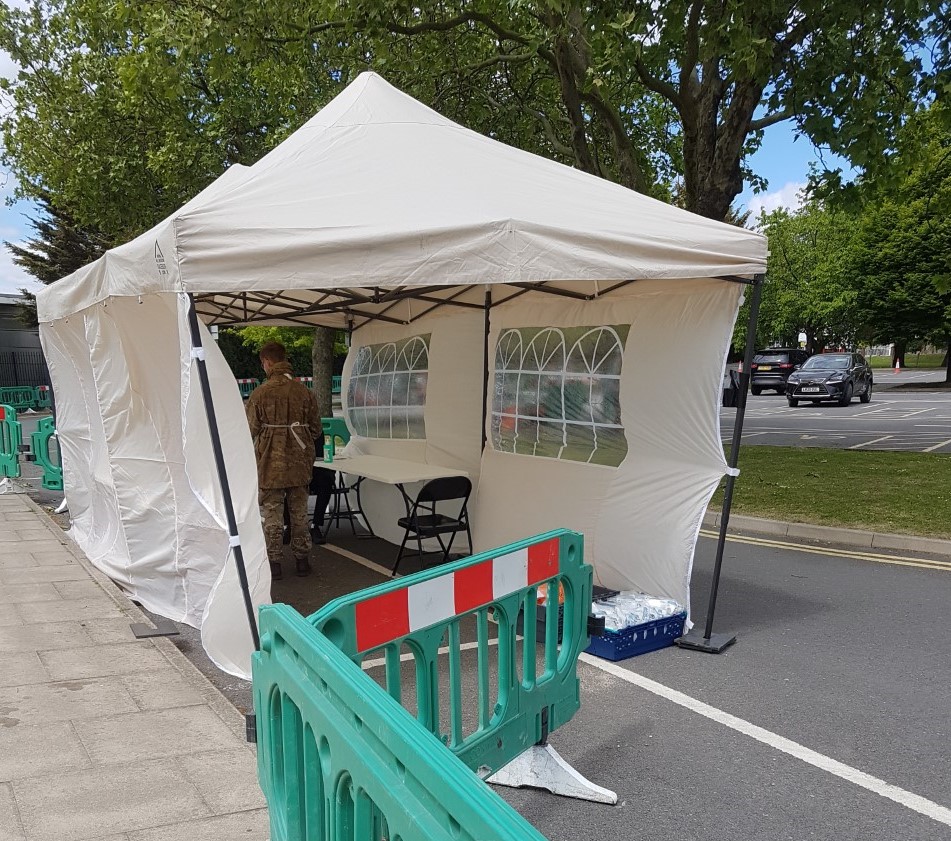
Nevertheless, I decided to get on my bike (for the first time in a couple of weeks) and cycle over to the sports centre. Sure enough, in the car park there was a gazebo set up, and some tape to create lanes for cars to queue, and a few soldiers in camouflage and PPE. There was a small sign saying ‘No public access, covid testing only’ to prevent people walking through the area. I asked a soldier if I could get tested. He said, Yes, no problem, just wait a few minutes – he was helping two people to get tested at the time. When my turn came, he asked me if I had been referred or was self-referring. Self-referring, I told him. I sat at a table and followed his instructions and read a printed leaflet. I carried out a swab test on my throat and nose, put the cotton bud thing into a vial, which went into a plastic bag, I stuck on some barcodes, took away a QR code with which I would later register on the government website, and off I went.
Army-run testing centre, 13 May 2020, north-west London
While I was waiting, the soldier had told me that they had been there a couple of days, and were packing up that afternoon. I asked if it had been busy. No, not really, he said – pretty quiet.
Well, no wonder! Because its existence seemed to be a well-kept secret. It certainly had no web presence. No mention of it on my local GP practice’s website. No signs at the tube station or outside Tesco.
While I am glad to have been able to get a test (albeit self-administered and potentially badly done), the system really is a farce. There was nothing to prevent me from getting a test even though I could have had one or more tests elsewhere – or have no symptoms or any reason to need one. I do not meet the government’s eligibility criteria – so what is the point of those critieria if they can simply be circumvented by turning up at a test centre? The potential for wasting resources is obvious.
Meanwhile my sister, a case worker for an NHS trust, is liaising with the 25 care homes and nursing homes in its area to support them during the pandemic. They are reporting to her that they are unable to get tests; or that they have received tests but do not know how to use them; or they have tested their residents but there is no courier available to take them to the lab.
A friend whose mother was removed from her care home because she tested positive for covid-19 (although then tested negative at the hospital where she was taken) tells me that the care home cannot test the other residents. It will not even test his mother’s boyfriend, also resident at the home, unless and until he shows symptoms. All for want of tests.
Can it be the right allocation of resources to set up a field centre for testing which will conduct tests on anyone who turns up – or sit there testing nobody – while there are care homes desperately in need of tests?
I feel rather uncomfortable that I have been tested in those circumstances, but the fact is that I have been feeling unwell for almost two weeks with symptoms which are considered covid symptoms anywhere but the UK, and whether I have or had the virus impacts on how I and my family can live our lives. Anyway, I await my test result – the government website gave me no indication of when I would receive it.
Meanwhile, down other rabbit holes … My employer requires a doctor’s note for absences of more than a week. My manager suggested that I could get a sick note for covid-19 on the 111 website, so I tried. However, because the NHS view is that my symptoms do not amount to covid, I could not obtain an ‘isolation’ note, as it’s called, by honestly stating my symptoms. To keep my employer happy, therefore, I decided to lie and say that I did have a fever and cough, the key to the special door. Beyond that door is a world of caring questions about how I am feeling, whether I am turning blue and so forth – and then the prize: the submission of my details to obtain the isolation note. However, the letter that was sent to me certified my ‘isolation’ (not illness or unfitness to work) for the period 4-10 May, a period of seven days inclusive. I have been off work for two weeks, because my symptoms (spurious though the NHS may deem them) have persisted for that length of time. So I need two isolation notes! I guess I should trick the system into sending me one for the next seven-day period.
All so that the human resources department at work can mark my absence as authorised. No doctor involved; no objective view of my illness. Just me tricking an online system to spew out a meaningless letter or two.
Last Friday I began to feel unwell: headache, muscle ache, lethargy and a strange taste in my mouth. By Monday my chest hurt – in fact I described it as feeling fizzy. According to the World Health Organization, the respected US Centers for Disease Control and Prevention (CDC), and the government websites of nearly all countries I have checked, including France, Spain, Canada and New Zealand, my symptoms clearly point to covid-19.
WHO lists the most common symptoms as fever, dry cough and tiredness. But it identifies other less common symptoms: aches and pains, nasal congestion, headache, conjunctivitis, sore throat, diarrhoea, loss of taste or smell, and a rash on skin or discolouration of fingers or toes – none of which are mentioned anywhere by the NHS.
Those other countries, as well as the CDC, all adopt various long lists of symptoms that largely overlap with the WHO list. It’s rather like researching a chicken soup recipe – everybody makes it a bit differently, but they all agree there are more ingredients than just chicken and water.
So, if I happened to live in nearly any other country, my symptoms would indicate that I had covid-19, and in many of them I would be tested, and of course told to isolate.
However, here in go-it-alone Britain we appear to have a different disease also known, confusingly, as covid-19. According to the NHS website, it presents as fever and/or a new, persistent cough. That’s all. They are described as the “main symptoms” but nowhere are any other symptoms mentioned. I did the self-assessment on 111, but as I did not have a fever or cough, predictably it said that I probably did not have covid-19. A visit to my GP’s website refers me back to the NHS covid page. So there you go – I don’t have covid-19! Great news! I don’t need to self-isolate – I can go to the supermarket and give all the avocados a good squeeze, I can sneeze on my shopping trolley, I can go for a run in the park (or I could if I had the energy).
And yet … this doesn’t seem quite right. Is it really the responsible thing for me to respectfully follow the NHS line, and conclude that I do not have covid-19, but rather some other unnamed illness? Should I blithely ignore the weight of evidence from around the world, both scientific and anecdotal, that my symptoms accord with covid-19? The WHO data I looked at was based on a study of 56,000 confirmed cases – can it really be wrong, while we here in Blighty have got it spot on? Doctors treating covid patients on a daily basis recount a wide range of symptoms, including mine.
Absurdly, because I am not eligible to be tested for covid-19, the decision is essentially mine as to whether I have it or not. While I don’t feel I can legitimately declare with certainty that I have it, equally it seems wrong to act as if I do not. It seems worrying that if I followed our government’s published guidance, I could legitimately say, I don’t have covid, and I can continue to go out (no mask required). Having weighed up the evidence, I have chosen to take the cautious route and self-quarantine. Already I know several people who have died of this disease, which brings home its seriousness, and I want to act responsibly.
I cannot be alone. Surely this narrow British view of the symptoms means that many people who probably should be self-isolating are not, so the spread of the disease is greater. Equally, because of the lack of testing, there must be people who are self-isolating who do not need to, causing them inconvenience (and worse), and depriving the workforce of important people. The narrow definition may also mean that sufferers do not seek medical help when they should. And surely it leads to a serious underestimate of the number of infected people. How many of us will never know if we had covid-19? Finally, it seems to me, trust in the NHS and government advice is seriously undermined.
The NHS is where I turn for impartial, best health advice based on science, and I am reluctant to knock it. Yet its covid-19 information appears to be either hopelessly out of touch, or to smack of political meddling, part of a futile bid to downplay the pandemic. My confidence is shaken. My research into the information available elsewhere has revealed websites rich in detailed and supportive information, compared with the minimal (and probably wrong) data on the NHS website. (Incidentally, I have noticed guidance elsewhere available in many languages, while the NHS is English-only (eg the Canadian province of Alberta, with a population of 4.3 million, has covid advice in 15 languages).
Is it any wonder that we now hold Europe’s top spot for covid-19 deaths? We always knew we were exceptional. Each country has responded differently to this pandemic, and in the realms of economic and political decisions such as what financial support to offer, how to manage a lockdown, how to plan for the future, perhaps that is inevitable. But it seems particularly worrying that this misplaced British sense of righteousness even extends to ignoring the near-global consensus in science. And how depressing when this country has such a fine tradition of scientific excellence.
Surely the NHS must accept the evidence gathered around the world and reflect it in its description of and approach to this disease? And that must happen hand-in-hand with widespread testing and tracing. We are the sixth richest country in the world – is that really too much to expect?
In the meantime, I’ll continue to stay at home, resting and washing my hands – and I’ll stand outside this evening to bang my drum for the NHS workers.
Comparison chart produced by WHO and CDC and available since mid-March
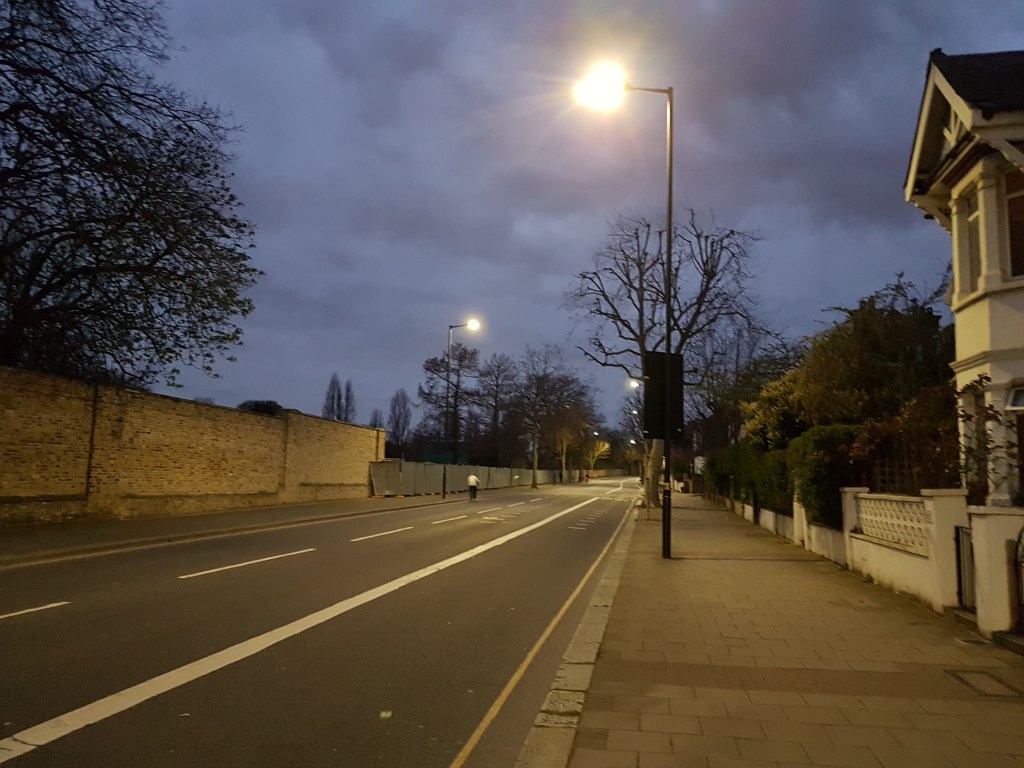
As was widely reported in early April, traffic has reduced to levels not seen for 60 years (see for example the Guardian). And how lovely it is. For the first time, I have felt safe cycling with my children along London’s streets. They play football in the road. Joggers, wisely conscious of social distancing, are running on the road rather than the pavement, occupying expanses of tarmac normally covered with gridlocked vehicles. The air is clean, and one can have a conversation without shouting. Buses complete their routes in record time. If only we were not in lockdown, the city would be ours to explore on foot, bike or bus without all the sadly familiar impediments created by excessive vehicle use: air and noise pollution, danger, slow journey times.
Fleet Street, London EC4, deserted at about noon on a Friday in April 2020
Of course the pandemic is dreadful, and the lockdown a great strain for many, but our quiet city streets are an unexpected silver lining – a vision of urban utopia.
I dread the return to normal. I hope that others might share my hope for a different future, after all of this. We need to hold on to this memory and push for it to become our new reality. I urge those who currently own vehicles and frequently use them in urban environments to think long and hard about whether you could change your habits, to reduce or omit your car use from your daily routine – to try cycling, walking or taking the bus instead. You would be better off. Your children, all children, would thank you for it. All asthma sufferers would thank you. The streets would become safer for disabled, elderly and vulnerable people. We would all be fitter. The drivers of essential vehicles – buses, emergency vehicles, delivery vans – would thank you as their journey times were reduced. The economy would benefit, because the cost of congestion is enormous. Our communities would flourish as people became visible and audible to each other, rather than enclosed in steel bubbles. The street could be a place where people spend time talking or playing, or simply sitting, rather than an environment merely to endure while going from A to B. Our ecosystem would improve.
Or we just go back to gridlock? We will learn many things from this pandemic; let this be one of them.
Harrow Road, by Kensal Green cemetery, weekday evening, April 2020
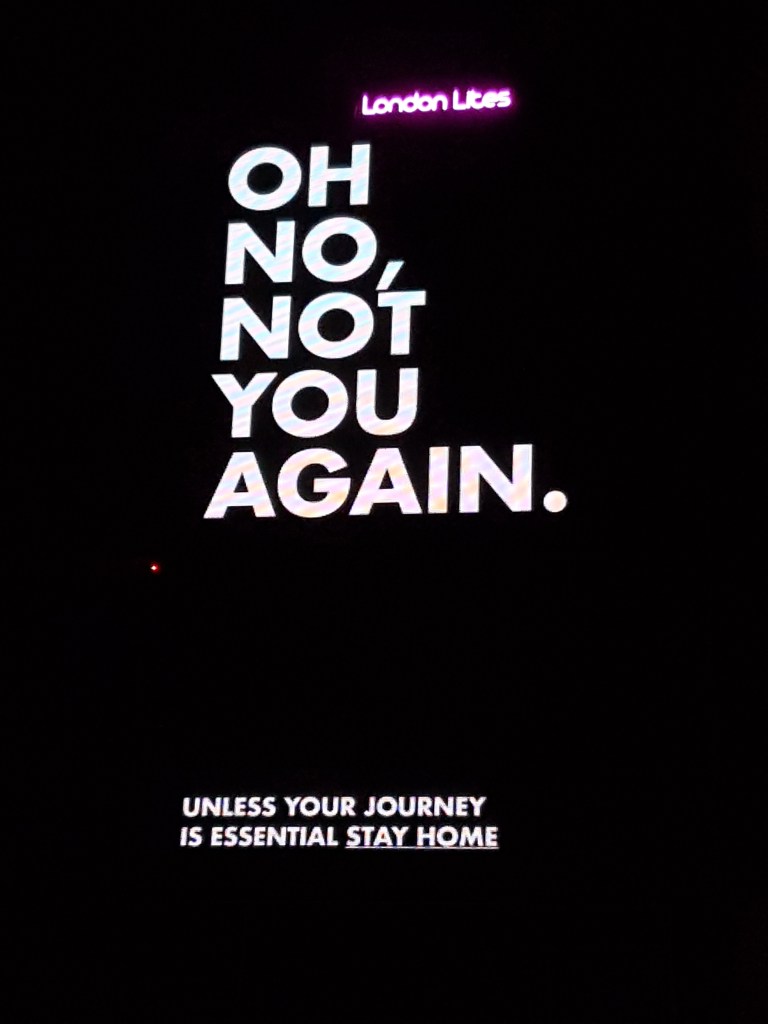
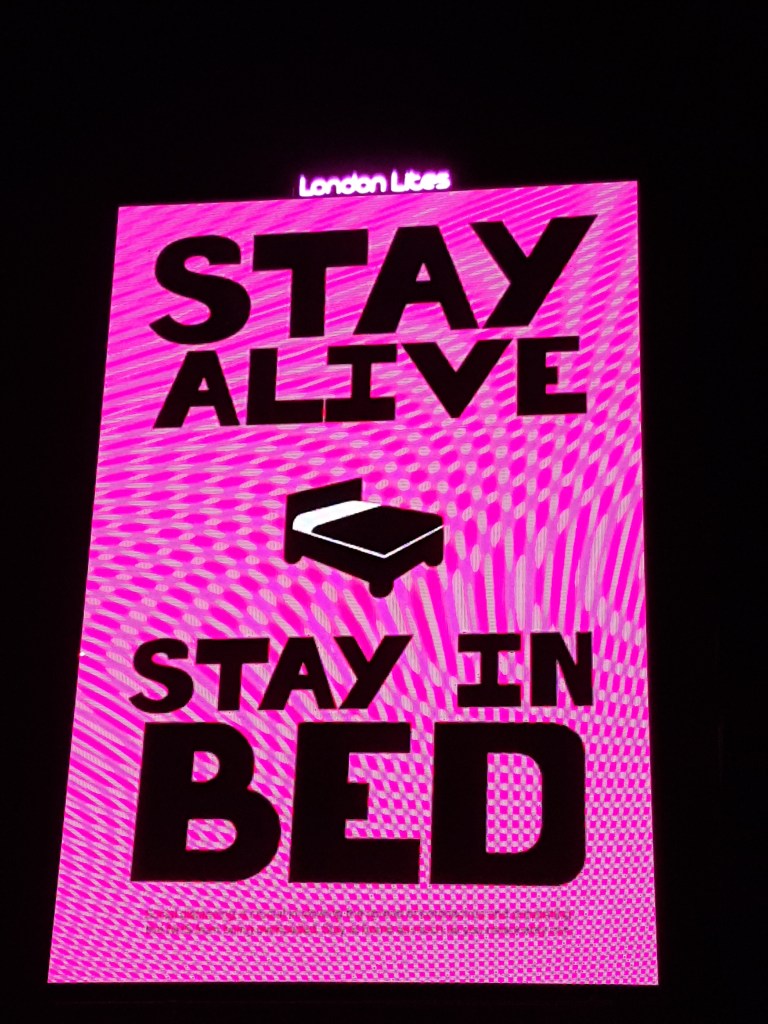
The covid-19 crisis has awoken the government, after a decades-long slumber, to the idea of providing public health information. And it has gone at it with some zeal: announcements on television and radio, in newspapers and on social media – and on billboards and large digital displays. Some are striking in their power and simplicity, laced with rye humour.
I suspect they are effective; ironically, hardly anyone will see the billboards if they are doing their job.
Yet this current campaign, probably uncontroversial in its purpose and necessity, begs the question why the government had not, until a couple of weeks ago, considered telling the public anything in such ways for years and years. We have a climate crisis brought about by our own behaviour. We have illegal, excessive air pollution in our cities caused in large measure by our use of private vehicles. Our love of flying is very harmful. All the science says that we need to act immediately to slow (forget reverse) climate change in time.
However, we have seen nothing from central government in terms of public guidance or education. No encouragement or admonishment. The Mayor of London has, in the last year or two, put out posters recommending public transport and walking and cycling (often displayed on the tube – preaching to the converted, surely). And many London boroughs, as well as cities like Oxford, are running public awareness campaigns about issues like idling engines. All to be welcomed of course.
But the broader, more fundamental crisis we face, which can be tackled only by national government? Not a peep.
You want to fly to Europe once a month for an exciting city break? You want to drive your children the mile to school in your Range Rover every morning? You want to buy a ton of concrete to pave over your front garden? The government is not going to say a word to you. It’s a free world, no?
The Covid-19 crisis is immediate and threatening, no doubt. But the climate crisis certainly poses a greater existential threat. Arguably it also requires more education of the public in that it seems more abstract and distant: it’s very hard to grasp that that hen weekend in Budapest (just six of us taking cheap flights! Once in a lifetime!) contributes significantly to a wider problem and might be disproportionate. Or that the gridlock traffic is composed of individuals all as decent, sensible and hardworking as you, all with their personal reasons for jumping in the car that day – or that your child strapped in the back might be coughing precisely because you and all the others are driving instead of walking.
So I was heartened to read that I am not alone in thinking that it is time that we started to put health warnings in places associated with fossil fuel use. This week a group of public health academics and professionals wrote in the British Medical Journal precisely along these lines. They advocate warnings on petrol pumps, airline tickets and energy bills, reminding consumers of the connection between fossil fuel use and the health issues associated with climate change. They point out that such warning signs are quite cheap interventions and target the people most responsible for harm.
Photo credit: The Swedish Association of Green Motorists / Martin Prieto Beaulieu
I think we must learn from this pandemic, and not simply go back to the old normal. Now that the government has rediscovered the utility of giving the public advice, it should keep it up, particularly in relation to the great crises of global warming and pollution.
Many products now carry health warnings or information about their environmental efficiency or the harm they cause.
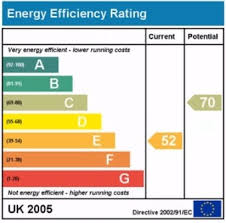
Houses and flats for sale or rent must have an energy performance certificate, on which they are graded from A (the best) to G (the worst). A national, accessible database holds this ever growing body of information. This is of course a good idea, not least because heating our homes is a major contributor to greenhouse gases.
If you go to buy yourself an electrical appliance, say a fridge or washing machine, it will come with a large information sheet or sticker telling you how efficient it is, ranging from the best score of A+++ down to a sad D. In fact, these data have become crucial marketing information, and will usually be a factor considered by a shopper when comparing models.
Packaging on all processed foods must contain a table of nutrition information – we may not read that small print, but it is there, holding manufacturers to account and helping the conscientious consumer.
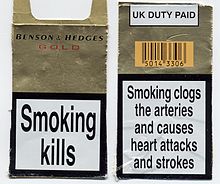
The visuals of tumours etc are horrible – I’ve chosen something less alarming here!
All cigarette packets display graphic images of tumours and destroyed lungs, and large words warning us that basically if we so much as open the pack, we’ll die a horrible death by next Tuesday. In fact those warnings cover 50% of the packaging, leaving the other half for the much diminished brand imagery.
Yet you can own and drive a car and never have to face up to the environmental impact and health hazards it represents. This seems outrageous to me. Everyone is affected by your choice of vehicle, yet nowhere are its emissions displayed publicly.
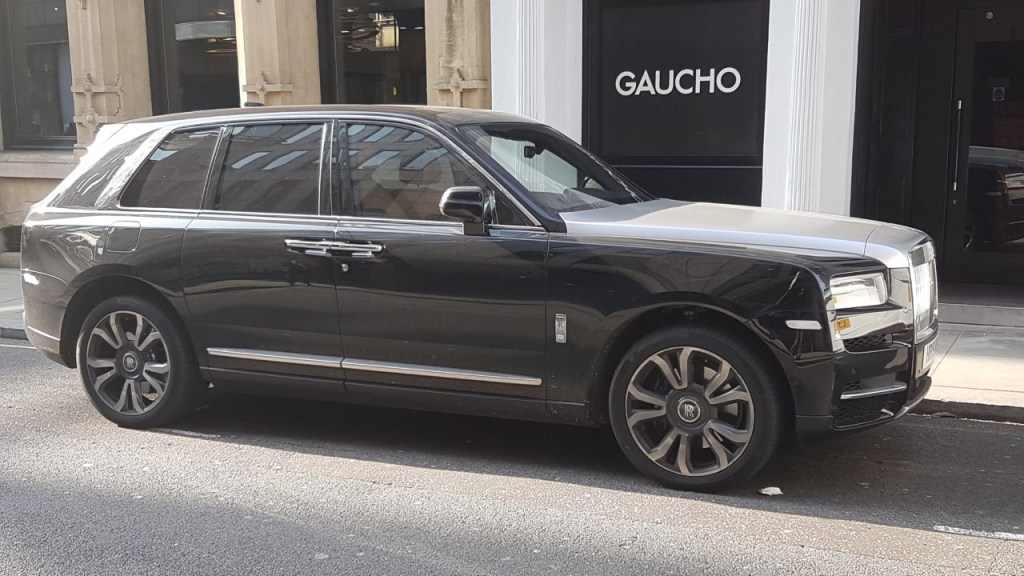
Imagine if cars had to display health warnings, as do cigarette packets. Picture a new Range Rover, with its driver’s door emblazoned with:
This car produces 209g/km of CO2
(EU target for average car 95g/km)
Or, more simply:
Emissions category D
Of course, this information would be better displayed graphically, more like the energy performance certificate above.
So, while the rest of the bodywork is beautifully finished in the sexy colour of your choice – manly black, or quirky canary yellow, the driver’s door is a standard government-approved notice, indelibly stuck on. On the passenger door, it could say:
Careful children – high-fronted heavy vehicle, much more likely to kill you
In fact, this could be seen as a rather moderate idea. To follow the analogy with the fag packet a bit further, half of the bodywork should be covered with the warnings – running from the front bumper, along the wing, the doors and to the rear lights.
Perhaps, just to reinforce the message, the interior could also display data for the driver and passengers, for when they grow accustomed to the messages on the exterior and need reminding.
Of course such a suggestion smashes hard up against several assumptions that we have all grown up with – that an individual is free to choose what car to buy and drive; that that choice is at least in part aesthetic, where the car’s styling and colour are a matter of taste and personal expression; and that the bodywork of a car is a thing of beauty and perfection, to be polished, repaired and kept immaculate. People have come to see their car as an extension of themselves, a statement to the world about who they are and what they have achieved and value. (Of course this goes hand in hand with another entrenched assumption – that we are free to drive our cars whenever and wherever we wish. Look at the furious reception congestion charges encounter when they are imposed.)
Yes, I anticipate the argument that what I am suggesting is a form of public shaming. I prefer to see it within a framework of accountability, freedom of information and awareness-raising. Fleet vehicles often carry the friendly question, “How am I driving?” with a phone number to call. This serves two linked purposes: first, to enable a system of reporting of a commercial driver’s behaviour, be it good or bad; second, to remind the driver that s/he is being watched and is therefore accountable. Both hopefully improve the driving of the company’s fleet. In a similar vein, public buses usually contain information about how one can give feedback about the driver.
Put simply, if a vehicle’s emissions are clearly displayed in a consistent manner, the public will learn more. And in the same way that the makers of domestic appliances strive to achieve good scores for their machines, so would the car manufacturers feel further pressure to improve the emissions of their latest models. Of course, they face serious targets from the likes of the EU, but they perhaps don’t carry the same weight as a well-informed buying public.
I think there is a need to alter the status quo, where we are free to drive whatever vehicle we like, however large or polluting, on any public road with impunity (subject to London’s new ULEZ, and the UK’s two congestion zones). I suspect many people are in denial about how polluting their vehicles are; this idea might begin to make such denial harder to sustain. Visual information on a vehicle could also work in conjunction with the data held publicly about all registered vehicles, and could be used in a system of differential treatment. For example, vehicles emitting over a certain level could be prohibited from certain parts of cities, or from zones around schools, or from parking in certain places. Conversely, vehicles with very low emissions could receive priority.
This is the seed of an idea that obviously needs refinement – any feedback welcome!
For the third year running the average CO2 emissions of new cars sold in the UK has risen. It stands at 127.9g of CO2 per kilometre – significantly above the target level of 95g introduced by the EU. This is despite the total number of new cars sold falling by 2.4%.
The average CO2 emissions figure has gone up 2.7% year on year, due to falling sales of diesel vehicles and the increasing popularity of SUVs. Each of those factors accounts for one quarter of the increase; half is explained by a change in the way the emissions are measured.
As the Guardian notes, the increase in SUVs between 2010 and 2018 was the second largest contributor to increased global CO2 emissions in that period.
This is a pretty depressing trend. Transport is key to reducing emissions, yet here we are buying an ever increasing number of heavy, thirsty vehicles – vehicles that frequently have off-road capabilities which are hardly ever required in our largely urban and temperate country. They are also more dangerous for other road users, because of their weight and, for pedestrians and cyclists, the height of their grills. Perhaps more surprisingly, they are also more dangerous for their occupants, as their higher centre of gravity makes them more prone to rolling. All in all, I find it a bit baffling why such cars are sold in ever greater numbers. Perhaps it is price? They are profitable models for the manufacturers, but is that the only explanation? More on this topic soon.
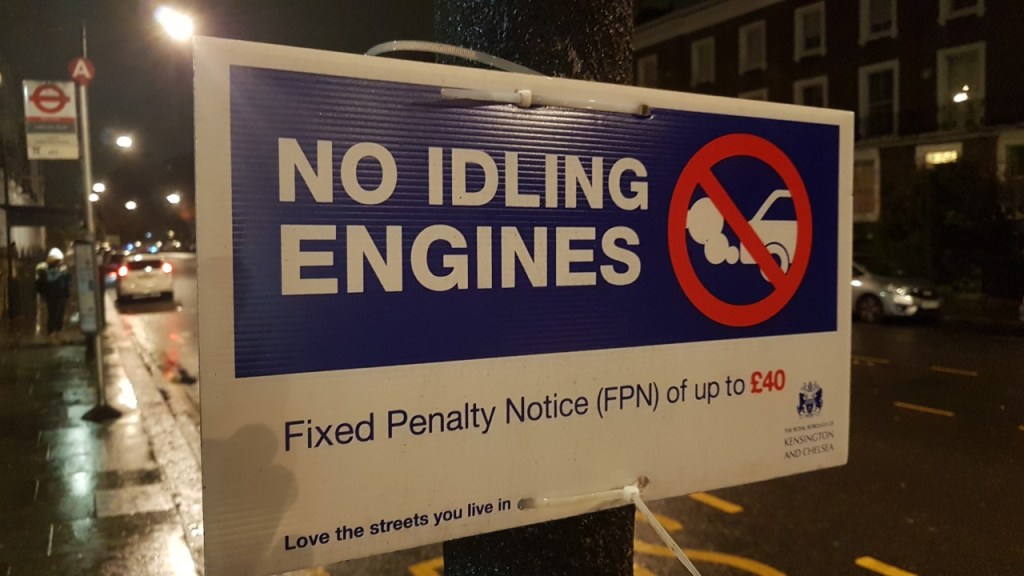
As my earlier post did not mention the law, I should clarify that parking with your engine idling is against the law! The law could be much clearer – drivers have to be warned before there can be enforcement, and there are various circumstances in which it is excused. And sometimes the fine is … wait for it … a whopping £20! Compare with littering, which in the London Borough of Brent attracts a £100 fixed penalty notice or up to a £2,500 fine in court. Or letting your dog foul the pavement, which can attract an £80 fixed penalty notice. I’m no fan of litter or dog turds, but those comparisons show that public policy treats idling engines as a fairly trivial problem.
Moreover, as far as I have been able to find out, the police do not enforce the anti-idling law at all. Only local authorities enforce, and then only if they have ‘authorised officers’ to do so.
In the street yesterday, I stopped a ‘civil enforcement officer’ for Kensington and Chelsea. Despite the bland, and potentially broad, job title, his task is to give out parking tickets. I asked him if he is empowered to give out tickets for idling. He said no, but there are warning leaflets that he can give out. However, when I asked if I could see one, he rather sheepishly said he wasn’t carrying any. He said that at present there is no enforcement in Kensington and Chelsea, because the council is trying to decide whether to deal with it internally, ie by employing its own officers, or to contract it out – like all the parking enforcement. He works for a private company that does that enforcement. He told me that his boss would ‘love the contract’ to ticket for idling, but he himself was less keen – he said it’s enough ‘aggro’ already giving out parking tickets when people park illegally for five minutes, and it would be much worse giving a ticket for idling instantly, ie without five minutes’ grace. I suggested that there are many more parked cars with their engines running at this time of year, because of the cold. He disagreed – he said in the summer it’s a problem, because of air-conditioning, in the winter because of heating. But he implied that there is really no off-season for idlers – there are always good reasons to keep those fires burning!
What’s clear is that there is enforcement only when it is monetised – and it should be said, some authorities have set fines higher than £20. However, the general picture on enforcement is that there really isn’t any. A freedom of information request in early 2019 revealed that of five local authorities who claimed to be actively enforcing the anti-idling law, three (Reading, Camden and Norwich) had not issued any FPNs in 2018, Southwark had issued nine, and Westminster 20*.
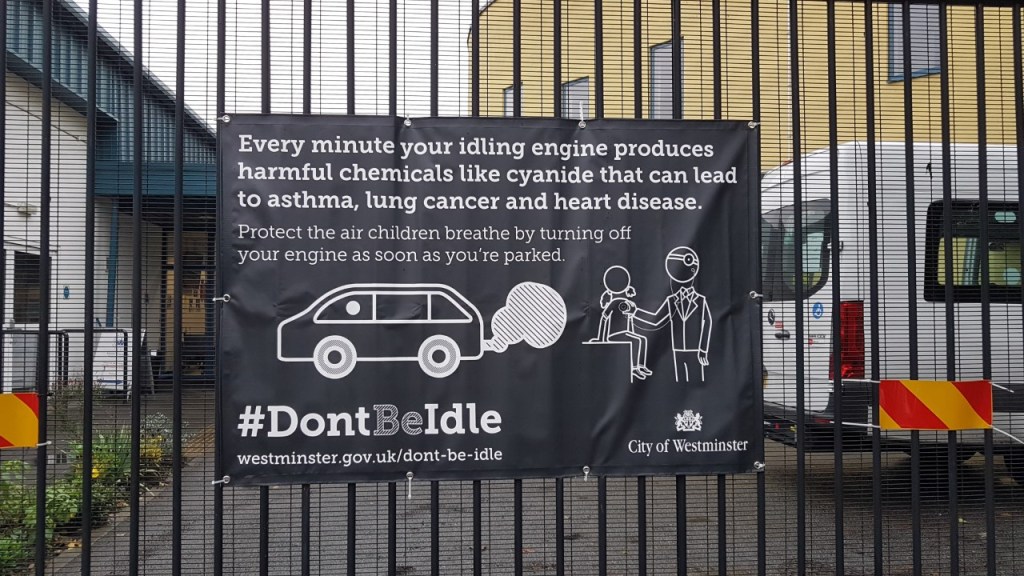
Local authorities are making some efforts in terms of public awareness, but generally warning notices are, it seems to me, placed only around schools (I shall add links to some of the better online campaigns). I don’t doubt that schools are entitled to clean air, and schools have concentrations of children so it’s not an unreasonable place to start a campaign against idlers (many of whom are probably the parents of the school children). But it’s important to remember that children are at school for under 20% of the hours in each week, and for about 39 weeks of the year. So, for the 85% of the year when they are not at school, they are somewhere else – mostly at home, but also in the street, the park, the shops – and in cars! Idling is a problem everywhere, and it poisons the occupants of cars too!
By keeping your engine running to keep your daughter warm while you wait for her brother to come out of after-school club, you are also poisoning her. Is that the right choice: she’s cosy, but inhaling carbon monoxide, nitrogen dioxide, and particulate matter which, the science seems to show, will stay in her lungs for the rest of her life? Or would it be better to put on coats, and maybe stroll up and down the pavement to keep warm. Or – crazy idea, I know – don’t collect your son by car at all.
The idlers are back in force. The temperature has dropped,
the mornings are dark, it’s November, and once again everybody is idling! As I
walk London’s streets, I estimate that I encounter a parked vehicle with its
engine ticking over at least once every 150 metres. In fact my experience is
that the majority of occupied parked vehicles have the engine running. And I’m
not even talking about the thousands of cars stuck in traffic, sitting in long
jams – amongst those, the proportion idling is close to 100%, even where it’s
apparent that nobody is going anywhere any time soon.
I go through phases of asking drivers of stationary vehicles to please turn off their engine. Here is a brief but representative medley of the responses I get.
Oh don’t worry mate,
I’m going in a minute
I’m charging my phone, my car battery will go dead if I turn the engine off
It’s none of your
business, it’s my car
It uses less fuel than
turning it off and starting it again
Many people simply ignore me, refuse to make eye contact and keep their window up. Once in a while, remarkably, somebody listens and turns off their engine. But most people are fairly hostile, because they don’t like being told off, especially by some smug, interfering stranger. Yet I don’t see why the air that I must breathe should be polluted because somebody else wants to keep warm for 10 minutes while they wait to collect their child from nursery, or finish a phone conversation, or sleep, or check their Instagram.
They should all turn their engines off! We have a climate emergency! We have dangerous and illegal levels of air pollution in our cities! Everybody knows it. I suspect that most drivers see their own idling engine as trivial in the big picture; and each has his own justification for idling – just as he also justifies his own need to drive, while being irritated by other road users, who form the traffic blocking his path.
But the problem is not trivial. Our cities are filled with
gridlocked traffic, all day, every day – tens of thousands of cars, which spend
most of their time stuck in a jam with their engine running. It is not the
exception; it’s the rule.
It seems to me that if people did one little thing to help tackle our dire pollution issue, it would be to turn off their car engine whenever they could. It’s so little effort, just the turn of a key, or the press of a button – but the effect across our cities would be huge. Immediately, the combined emissions of our vehicles would reduce, our streets would be a little quieter – and car owners would also all be a little better off, as they would save fuel.





 Bye bye car. Hello clean, friendly city