
Many products now carry health warnings or information about their environmental efficiency or the harm they cause.
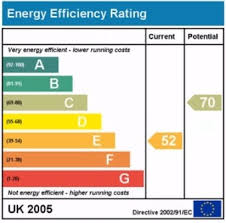
Houses and flats for sale or rent must have an energy performance certificate, on which they are graded from A (the best) to G (the worst). A national, accessible database holds this ever growing body of information. This is of course a good idea, not least because heating our homes is a major contributor to greenhouse gases.
If you go to buy yourself an electrical appliance, say a fridge or washing machine, it will come with a large information sheet or sticker telling you how efficient it is, ranging from the best score of A+++ down to a sad D. In fact, these data have become crucial marketing information, and will usually be a factor considered by a shopper when comparing models.
Packaging on all processed foods must contain a table of nutrition information – we may not read that small print, but it is there, holding manufacturers to account and helping the conscientious consumer.
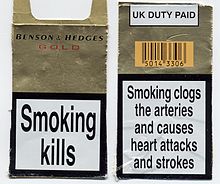
All cigarette packets display graphic images of tumours and destroyed lungs, and large words warning us that basically if we so much as open the pack, we’ll die a horrible death by next Tuesday. In fact those warnings cover 50% of the packaging, leaving the other half for the much diminished brand imagery.
Yet you can own and drive a car and never have to face up to the environmental impact and health hazards it represents. This seems outrageous to me. Everyone is affected by your choice of vehicle, yet nowhere are its emissions displayed publicly.
Imagine if cars had to display health warnings, as do cigarette packets. Picture a new Range Rover, with its driver’s door emblazoned with:
This car produces 209g/km of CO2
(EU target for average car 95g/km)
Or, more simply:
Emissions category D
Of course, this information would be better displayed graphically, more like the energy performance certificate above.
So, while the rest of the bodywork is beautifully finished in the sexy colour of your choice – manly black, or quirky canary yellow, the driver’s door is a standard government-approved notice, indelibly stuck on. On the passenger door, it could say:
Careful children – high-fronted heavy vehicle, much more likely to kill you
In fact, this could be seen as a rather moderate idea. To follow the analogy with the fag packet a bit further, half of the bodywork should be covered with the warnings – running from the front bumper, along the wing, the doors and to the rear lights.
Perhaps, just to reinforce the message, the interior could also display data for the driver and passengers, for when they grow accustomed to the messages on the exterior and need reminding.
Of course such a suggestion smashes hard up against several assumptions that we have all grown up with – that an individual is free to choose what car to buy and drive; that that choice is at least in part aesthetic, where the car’s styling and colour are a matter of taste and personal expression; and that the bodywork of a car is a thing of beauty and perfection, to be polished, repaired and kept immaculate. People have come to see their car as an extension of themselves, a statement to the world about who they are and what they have achieved and value. (Of course this goes hand in hand with another entrenched assumption – that we are free to drive our cars whenever and wherever we wish. Look at the furious reception congestion charges encounter when they are imposed.)
Yes, I anticipate the argument that what I am suggesting is a form of public shaming. I prefer to see it within a framework of accountability, freedom of information and awareness-raising. Fleet vehicles often carry the friendly question, “How am I driving?” with a phone number to call. This serves two linked purposes: first, to enable a system of reporting of a commercial driver’s behaviour, be it good or bad; second, to remind the driver that s/he is being watched and is therefore accountable. Both hopefully improve the driving of the company’s fleet. In a similar vein, public buses usually contain information about how one can give feedback about the driver.
Put simply, if a vehicle’s emissions are clearly displayed in a consistent manner, the public will learn more. And in the same way that the makers of domestic appliances strive to achieve good scores for their machines, so would the car manufacturers feel further pressure to improve the emissions of their latest models. Of course, they face serious targets from the likes of the EU, but they perhaps don’t carry the same weight as a well-informed buying public.
I think there is a need to alter the status quo, where we are free to drive whatever vehicle we like, however large or polluting, on any public road with impunity (subject to London’s new ULEZ, and the UK’s two congestion zones). I suspect many people are in denial about how polluting their vehicles are; this idea might begin to make such denial harder to sustain. Visual information on a vehicle could also work in conjunction with the data held publicly about all registered vehicles, and could be used in a system of differential treatment. For example, vehicles emitting over a certain level could be prohibited from certain parts of cities, or from zones around schools, or from parking in certain places. Conversely, vehicles with very low emissions could receive priority.
This is the seed of an idea that obviously needs refinement – any feedback welcome!
 Bye bye car. Hello clean, friendly city